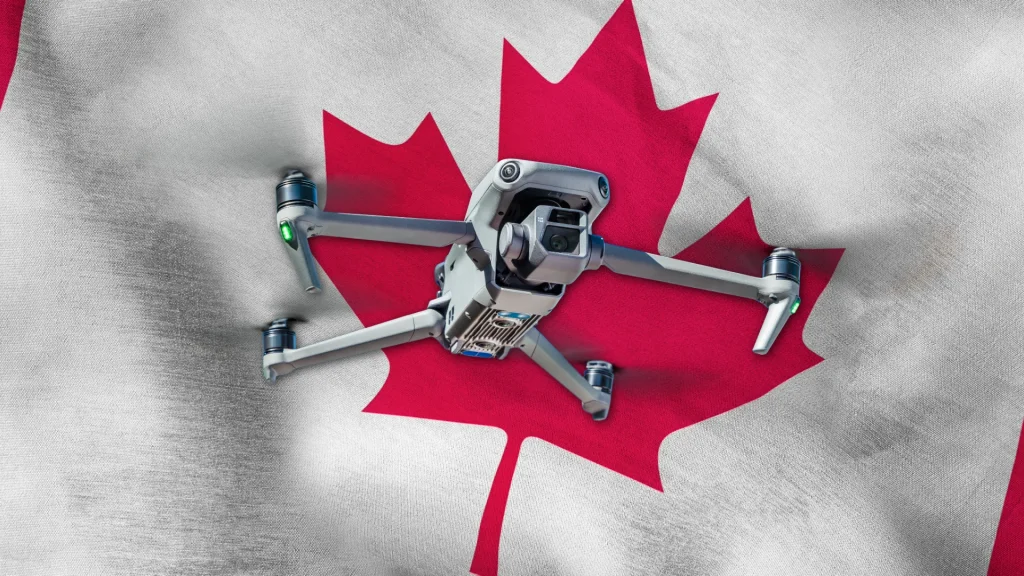
How the DJI Ban in the USA Will Affect Canada: What Canadian Drone Pilots and Businesses Need to Know
The United States has made a move that will permanently reshape the North American drone industry, and while the policy change happened south of the border, its effects will not stop there. With the U.S. Federal Communications Commission formally blocking the import and sale of all new foreign-made drone models and critical components by placing them on its Covered List, DJI and other major non-U.S. manufacturers are effectively locked out of the future American market.
For Canadian drone pilots, businesses, retailers, and training providers, this raises an unavoidable question: how will the U.S. DJI ban affect Canada?
The short answer is that Canada is not banning DJI, and Canadian pilots are not suddenly breaking the law. The longer and more important answer is that Canada is deeply connected to the U.S. drone economy, and this decision will create supply chain disruptions, pricing pressure, market shifts, and regulatory conversations that Canadians cannot ignore.
This article breaks down what is happening, why it matters to Canada, and what drone users north of the border should realistically expect over the coming months and years.
What the United States Actually Did and Why It Matters Beyond Its Borders
The FCC’s decision to add foreign-made unmanned aircraft systems and critical drone equipment to its Covered List is not a flight ban. It does not ground drones already in use, and it does not make it illegal to own or fly existing DJI drones in the United States. What it does do is far more strategic and long-term.
By denying future FCC equipment authorizations, the U.S. has shut the door on all new foreign-manufactured drone models entering the American market. Without FCC approval, a drone cannot be legally imported or sold, regardless of whether aviation authorities permit it to fly. This effectively freezes DJI and other foreign manufacturers out of future U.S. hardware sales.
This decision was framed as a national security measure tied to data, supply chain control, and reliance on foreign technology. Whether one agrees with that assessment or not, the result is clear: the world’s largest consumer and commercial drone market is no longer open to new DJI products.
Canada, while legally independent in its aviation and trade policies, shares a tightly integrated drone ecosystem with the United States. That integration is where the ripple effects begin.
Canada Is Not Banning DJI but the Market Will Still Change
As of now, DJI drones remain fully legal in Canada. Canadians can still import, sell, register, and fly DJI drones under Transport Canada rules. There has been no announcement of a Canadian ban, no change to Canadian Aviation Regulations, and no indication that Transport Canada plans to mirror the FCC’s Covered List approach.
However, legality does not equal insulation.
Canada does not operate in a vacuum. Drone manufacturing, distribution, pricing, inventory management, and product launches are all handled at a regional or global level. When the United States removes itself as a destination for new DJI hardware, manufacturers and distributors are forced to rethink production volumes, shipping priorities, and market allocation.
That recalibration will affect Canada whether policymakers intend it to or not.
Supply Chains Will Feel the Impact First
One of the most immediate and realistic consequences for Canada will be changes in drone availability. DJI has historically treated North America as a unified market, with product launches, inventory shipments, and repair infrastructure built around serving both the U.S. and Canada efficiently.
With the U.S. market now closed to new DJI models, DJI and its partners will need to decide how much inventory is worth allocating to Canada alone. Canada is a strong market, but it is significantly smaller than the United States. That difference matters when production runs are planned months or years in advance.
Canadian retailers may begin to see slower restocks, limited quantities of new releases, and higher wholesale costs as economies of scale shrink. In some cases, Canada may receive fewer units of new drones or experience longer delays between global releases and Canadian availability.
Over time, this can lead to price increases, not because Canada has banned DJI, but because the supply dynamics have fundamentally changed.
Canadian Drone Prices Are Likely to Rise
When a manufacturer loses access to its largest market, costs tend to rise elsewhere. Research, development, compliance, and manufacturing expenses do not disappear just because one market is closed. Those costs are redistributed.
For Canadian buyers, this could mean higher prices for drones, batteries, controllers, and replacement parts. Even if DJI continues to support Canada fully, smaller production volumes often lead to higher per-unit costs. Retailers may also face higher shipping, warehousing, and compliance expenses as supply routes are adjusted.
This pricing pressure is not limited to DJI. Competing manufacturers may also raise prices as demand increases for non-DJI alternatives, especially if Canadian buyers begin diversifying away from a single dominant brand.
Cross-Border Grey Markets and Enforcement Pressure
Whenever a major market closes while a neighbouring market remains open, grey markets emerge. With the U.S. no longer allowing new DJI drones to be sold domestically, American buyers may look north.
Canada could become an attractive source for DJI drones that are still legal to sell and purchase. This creates a risk of cross-border reselling, informal exports, and unauthorized imports into the U.S. While Canadian sellers may be acting legally under Canadian law, U.S. authorities are unlikely to ignore large-scale circumvention.
As a result, Canadian retailers and distributors could face increased scrutiny, tighter export controls, and pressure to demonstrate compliance with cross-border trade regulations. Even individual pilots travelling with drones could encounter increased questions at the border as enforcement evolves.
This does not mean Canadian pilots should expect their drones to be seized, but it does mean border dynamics are likely to become more complex and less predictable.
Canadian Drone Businesses Face Strategic Decisions
For Canadian businesses that rely on DJI drones for professional work, the impact will be gradual but significant. DJI dominates sectors such as real estate photography, cinematography, agriculture, surveying, inspection, and mapping. These businesses depend on consistent access to hardware upgrades, batteries, and spare parts.
While existing fleets remain legal and operational, long-term planning becomes critical. If DJI’s ability to refresh its product lineup in North America slows or stops, Canadian businesses may find themselves holding aging equipment longer than planned. That can affect competitiveness, efficiency, and image quality in industries where technology moves quickly.
Some Canadian companies may begin to diversify their fleets, adding alternative platforms to reduce reliance on a single manufacturer exposed to geopolitical risk. Others may choose to stockpile critical components or extend maintenance cycles to keep existing aircraft in service longer.
None of this requires panic, but it does require foresight.
Public Safety and Government Use Could Influence Policy Discussions in Canada
One of the drivers behind the U.S. decision was the government and public safety use of drones. In the United States, many agencies had already been restricted from purchasing DJI drones with federal funds. The FCC decision accelerates that separation entirely.
Canada’s public safety and government agencies continue to use DJI drones widely due to their reliability, cost-effectiveness, and advanced capabilities. However, the U.S. decision may prompt Canadian policymakers to revisit questions around procurement, data security, and domestic manufacturing capacity.
Canada does not face the same political pressures or defence priorities as the United States, but it often aligns with allied nations on technology policy over time. Even if Canada never adopts a similar ban, increased scrutiny and evaluation of foreign-made drones is likely.
For private pilots, this matters because government policy often trickles down into broader regulatory frameworks over the long term.
Opportunities for Canadian Drone Manufacturers and Developers
While much of the conversation focuses on risk, the U.S. DJI ban also creates opportunity, particularly for Canadian innovation. With DJI excluded from future U.S. hardware sales, demand for alternative platforms will grow. That demand does not stop at the border.
Canadian drone manufacturers, component suppliers, and software developers may find new opportunities to fill gaps left by DJI’s absence in the U.S. market. Canadian-made or allied-nation drones could become more attractive to American partners looking for compliant systems.
Beyond hardware, software and services are poised for growth. Flight management platforms, mapping software, analytics tools, and AI-driven inspection systems do not face the same import restrictions as physical drones. Canada has strong talent in these areas, and regulatory shifts often accelerate investment into software-based solutions.
Recreational Pilots Will Feel the Effects Last but Still Feel Them
For recreational drone pilots in Canada, the effects of the U.S. ban will likely be the slowest and least disruptive. Flying rules in Canada remain unchanged. DJI drones are still legal. Training, registration, and operational requirements remain exactly the same.
However, hobbyists may eventually notice fewer new models, higher prices, or reduced availability of accessories. The excitement of global product launches may feel more muted if Canada becomes a secondary market rather than part of a unified North American rollout.
This is not a loss of freedom to fly, but it is a shift in consumer experience.
Why Canada’s Response Will Likely Be Different From the U.S.
Canada regulates drones primarily through a safety and airspace lens rather than a national security one. Transport Canada focuses on risk to people, aircraft, and infrastructure rather than the geopolitical origins of hardware. That philosophical difference matters.
Canada also benefits from remaining flexible. A full ban would raise costs for Canadian businesses, slow innovation, and reduce competitiveness without delivering the same strategic gains the U.S. seeks. For these reasons, Canada is unlikely to mirror the U.S. approach in the near term.
However, alignment pressure exists. Canada participates in shared security frameworks, intelligence partnerships, and trade agreements. While an outright ban may be unlikely, increased oversight and evaluation are almost guaranteed.
What Canadian Drone Pilots and Businesses Should Do Now
The most important takeaway for Canadians is this: there is no need for panic, but there is a need for awareness.
Canadian drone owners do not need to ground their aircraft. There is no reason to sell equipment out of fear. Flights remain legal. Certifications remain valid.
At the same time, pilots and businesses should recognize that the market environment has changed. Planning ahead, maintaining equipment carefully, and staying informed about supply trends will matter more than ever. Those who adapt calmly and strategically will be far better positioned than those who react emotionally to headlines.
The Bottom Line: How the DJI Ban in the USA Will Affect Canada
The U.S. DJI ban is not a Canadian ban, but it is a North American market event. Canada will feel its effects through pricing, availability, supply chains, and long-term industry direction. The skies over Canada remain open, but the economic and technological landscape beneath them is shifting.
For Canadian drone pilots, the future remains bright, but it will reward those who understand that regulation, geopolitics, and technology are now inseparable parts of modern aviation.
Staying informed is no longer optional. It is part of being a responsible drone pilot in a connected world