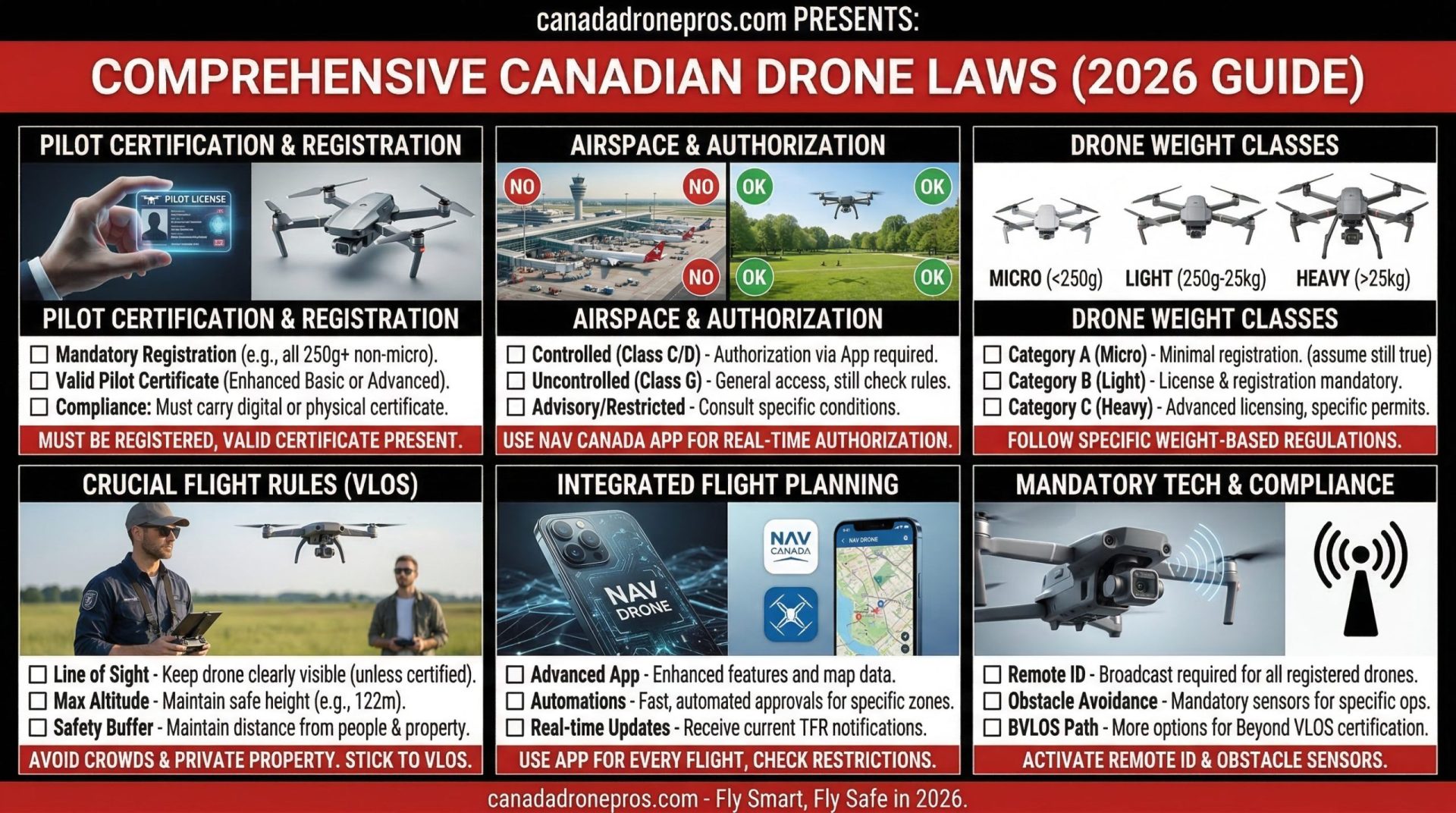
Drone Laws in Canada (2026 Guide)
Updated for 2026 Transport Canada RPAS Regulations
Drones are no longer a novelty in Canada. From aerial photography and real estate to agriculture, inspections, and emergency response, remotely piloted aircraft systems (RPAS) are now part of everyday airspace. As access to drones has increased, so has the responsibility that comes with flying them safely and legally.
What many new pilots don’t realize is that flying a drone in Canada is a regulated aviation activity—not a toy hobby. Even recreational flights can carry legal consequences if rules are ignored or misunderstood.
This guide breaks down Canada’s drone laws as they stand in 2026, including certification, registration, airspace rules, park restrictions, penalties, and the major regulatory updates that took effect in November 2025.
Why Drone Laws Exist in Canada
Canada’s drone regulations were developed in response to real-world incidents and growing safety concerns. Drones have interfered with commercial aircraft, disrupted wildfire suppression efforts, entered restricted airspace, disturbed wildlife, violated privacy, and posed risks to public safety.
Globally, drones have also demonstrated their impact in modern conflict zones, reinforcing the need for structured airspace management.
As a result,Transport Canada regulates drone operations nationwide, while provinces, municipalities, and park authorities may impose additional restrictions based on local needs.
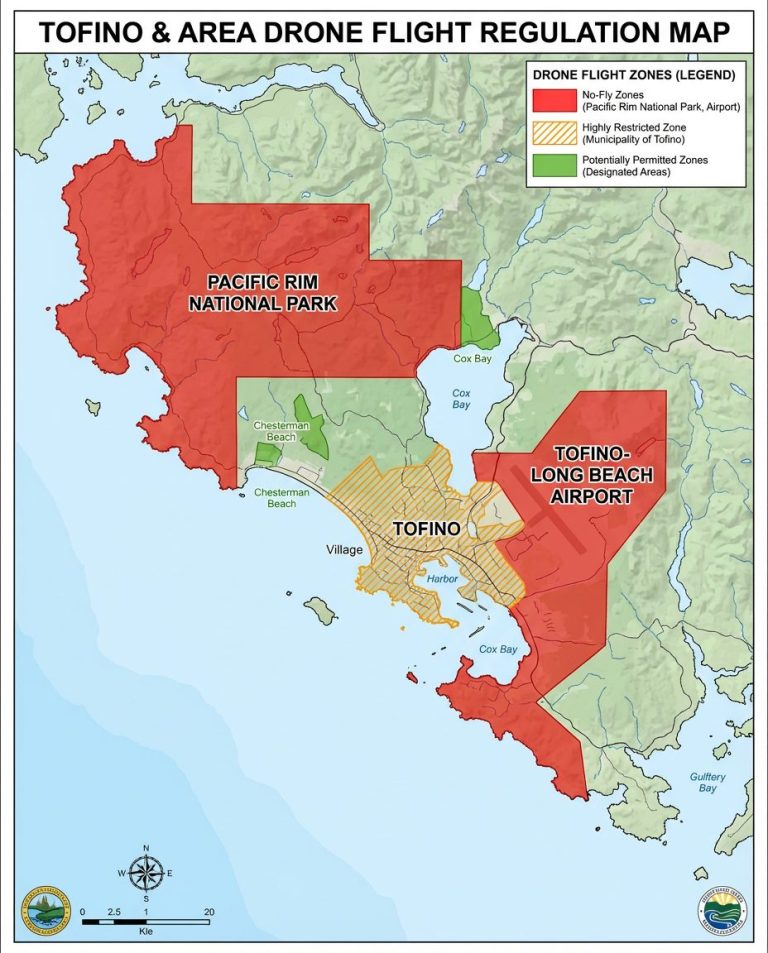
Some communities, such as parts of Vancouver Island and environmentally sensitive areas, have gone as far as banning drone use entirely.
Which Drones Are Regulated in Canada?
Drone regulations in Canada are based primarily on weight.
Regulated Drones
Any drone weighing more than 250 grams is regulated under Part IX – Remotely Piloted Aircraft Systems of the Canadian Aviation Regulations (CARs).
These rules govern:
- Pilot certification
- Drone registration
- Where and how drones may be flown
- Operational limitations
- Safety responsibilities
If your drone falls into this category, you are legally responsible for understanding and following CARs Part IX before you fly.
Ignoring these rules can lead to fines, confiscation of equipment, or more serious consequences.
Drone Pilot Certification & Registration (Canada)
Before flying a regulated drone in Canada, pilots must meet both certification and registration requirements.
Who Needs Certification?
- Under 250 g:
No licence or registration required (still must fly safely and legally) - 250 g to 25 kg:
You must:- Hold a Basic or Advanced Pilot Certificate
- Register each drone with Transport Canada
Age Requirements
- Basic Certificate: Minimum age 14
- Advanced Certificate: Minimum age 16
- Level 1 Complex (BVLOS): Minimum age 18
Drone Registration
- Register online through Transport Canada
- Cost: $5 per drone
- Registration number must be clearly displayed on the aircraft
Basic vs Advanced Drone Certification
Basic RPAS Certificate
Allows flight:
- In uncontrolled (Class G) airspace
- Away from bystanders
- Within visual line of sight (VLOS)
Best for recreational pilots and low-risk operations.
Advanced RPAS Certificate
Required for:
- Controlled airspace
- Flying near people or buildings
- More complex professional operations
Advanced pilots may request airspace authorization through NAV CANADA.
Want To Fly Drones Legally?
Prepare for the Transport Canada RPAS Certification exam with our pro’s
Core Drone Operating Rules in Canada
Regardless of certification level, all pilots must follow these fundamental rules:
Visual Line of Sight (VLOS)
- You must keep the drone visible at all times
- FPV-only flying is not permitted without a visual observer
Altitude Limit
- Maximum altitude: 122 metres (400 feet) AGL
Distance From People
- Basic operations: Minimum 30 metres horizontally from bystanders
- Advanced operations: May fly closer using compliant drones and approved procedures
Restricted Areas
You may not fly:
- Near emergency scenes
- Over-advertised public events
- Around hospitals or emergency response zones
- In restricted or controlled airspace without authorization
Violations can result in severe penalties.
Canadian Airspace & Where You Can Fly
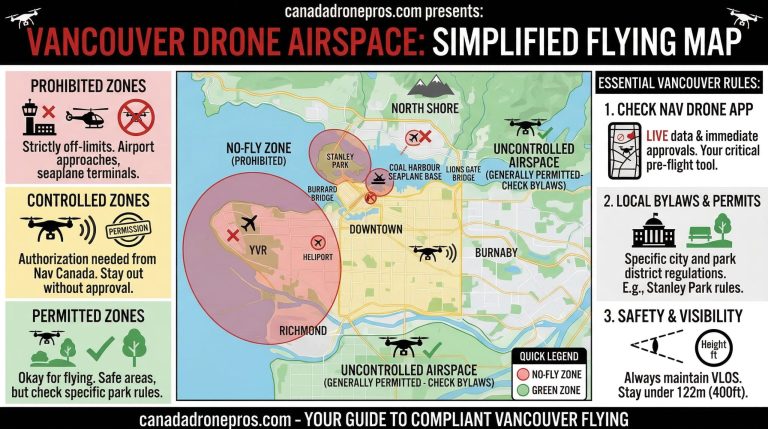
Understanding airspace is essential for safe and legal drone operations.
Controlled Airspace (Classes C, D, E)
- Found around airports and major flight corridors
- Requires:
- Advanced Certificate
- NAV CANADA RPAS Flight Authorization
Class F Airspace
- Restricted or advisory areas
- Military bases, security zones, critical infrastructure
- Authorization required for entry
Temporary Flight Restrictions
- Established during:
- Wildfires
- Police operations
- Search and rescue
- Disaster response
- Flying here is illegal and dangerous
Basic Certificate Distance Limits
Basic pilots must remain:
- 3 nautical miles (5.6 km) from airports
- 1 nautical mile (1.8 km) from heliports
Where You Can Fly Without Special Permission
You may fly legally when operating:
- In uncontrolled (Class G) airspace
- Below 400 ft AGL
- Within VLOS
- Away from people, airports, and emergency zones
National & Provincial Parks in Canada
National Parks (Parks Canada)
- Drone use is prohibited
- Exceptions require written permission for:
- Filmmaking
- Research
- Resource management
Penalties may include:
- Fines up to $25,000
- Equipment confiscation
Drone Laws in Provincial Parks Across Canada (2026)
British Columbia
In BC Parks, drones are prohibited without a permit.
This applies to:
- Launching
- Landing
- Operating from within park boundaries
Permits are only issued for:
- Commercial filming
- Research
- Government use
Recreational or casual commercial use (like real estate-style content or social media filming) is almost always denied.
Real-world implication (important for you in Northern BC):
Even if you’re Advanced certified and in legal airspace, you cannot legally take off from inside a BC provincial park without approval.
However, you can:
- Launch outside park boundaries
- Fly over the park (if compliant with Transport Canada rules)
This is a common workaround used by professionals—but you must be extremely careful with:
- Takeoff location
- Wildlife disturbance
- Visual line of sight
Alberta
In Alberta Parks, drones are generally prohibited without authorization.
You must obtain a permit for:
- Any commercial use
- Most recreational use
Alberta is slightly more structured than BC in how permits are issued, especially for:
- Tourism campaigns
- Commercial filming
However, casual drone flying in parks is still not allowed.
Key difference from BC:
Alberta sometimes provides clearer permitting pathways for commercial operators, but you still need approval beforehand.
Ontario
In Ontario Parks, drones are strictly prohibited for recreational use.
Permits may be granted for:
- Commercial filming
- Research
- Government operations
Ontario is one of the stricter provinces in terms of enforcement.
Important detail:
Even launching a microdrone (under 250g) is still considered a violation without a permit.
Quebec
In Sépaq parks, drones are prohibited without authorization.
Permits are required for:
- Commercial filming
- Scientific work
Quebec enforces this fairly strictly, especially in high-traffic parks.
Additional factor:
Language and permitting processes can be more complex, especially for out-of-province operators.
Saskatchewan
In Saskatchewan Parks, drone use is restricted and requires permission.
Recreational flying is generally not allowed without approval.
However, enforcement is often less aggressive compared to provinces like Ontario or BC.
Still, legally:
- You should not fly without permission
- Commercial use requires authorization
Manitoba
In Manitoba Parks, drones are not allowed without a permit.
Permits are typically issued for:
- Commercial filming
- Government work
- Research
Manitoba follows a similar model to other provinces: default restriction with case-by-case approval.
Nova Scotia
In Nova Scotia Parks, drone use is restricted and generally prohibited without permission.
Permits may be issued for:
- Commercial use
- Special projects
However, casual recreational flying is not permitted.
New Brunswick
In New Brunswick Parks, drones are prohibited without authorization.
Permits are required for:
- Commercial filming
- Organized projects
This province follows a similar enforcement model to Nova Scotia.
Prince Edward Island
In PEI Provincial Parks, drones are generally not allowed without permission.
Due to the smaller size of parks and higher population density:
- Enforcement tends to be stricter in visible areas
Newfoundland and Labrador
In Newfoundland and Labrador Parks, drones are restricted and require approval.
Permits are required for:
- Commercial use
- Research
Recreational use is typically not permitted.
Yukon
In Yukon Parks, drones are restricted and require permission.
Due to wildlife sensitivity and remote environments:
- Regulations are taken seriously
However, enforcement varies depending on location.
Northwest Territories
In NWT Parks, drones are generally restricted.
You must obtain permission for:
- Most operations
Given the remote nature of the territory, enforcement is less visible—but the rules still apply.
Nunavut
In Nunavut Parks, drone use is restricted and often requires authorization.
Due to cultural, environmental, and wildlife considerations:
- Permissions are taken seriously
- Operations are evaluated case-by-case
The Most Important Rule (Across All Provinces)
Almost every province follows the same core principle:
Drones are NOT allowed in provincial parks without permission.
This includes:
- Recreational flying
- Content creation
- Commercial shoots
The Legal Loophole (Used by Professionals)
Here’s where it gets interesting—and where experienced operators separate themselves from amateurs.
Provincial laws regulate:
- Land use (takeoff/landing)
But Transport Canada regulates airspace.
So technically:
- You can launch outside a park
- Fly over the park (if compliant with RPAS laws)
However, this comes with risks:
- Wildlife disturbance violations
- Park-specific enforcement interpretations
- Visual line of sight challenges
In practice, this method is commonly used—but must be done carefully and professionally.
What This Means for Your Drone Business
For your type of work—commercial content, marketing, industrial—you need to approach parks strategically:
What You SHOULD do:
- Get permits for high-value shoots
- Launch outside park boundaries when legal
- Focus on adjacent areas (often just as scenic)
What You SHOULD avoid:
Relying on microdrone loopholes
Casual flying inside parks
Assuming remote = allowed
Special Flight Operations Certificate (SFOC)
Certain operations require an SFOC, including:
- Flying over large public events
- Dropping payloads
- Multiple drones from one control station
- Higher-risk or non-standard operations
Important Update
As of November 4, 2025, some lower-risk BVLOS operations will no longer require an SFOC if pilots and operators meet new certification requirements.
Privacy & Other Laws
Drone pilots must also respect:
- Privacy laws
- Trespassing laws
- Criminal Code provisions
Recording people without consent or invading private spaces can result in criminal charges—even if aviation rules were followed.
Posting footage online does not protect you from enforcement later.
Fines & Penalties (2026)
Individuals
- Up to $1,000 for unlicensed or unregistered flights
- Up to $3,000 for serious violations
Businesses
- Up to $5,000 for administrative violations
- Up to $15,000 for severe breaches
Multiple offences can stack from a single flight.
Major Transport Canada Updates – November 2025
Transport Canada is implementing the largest RPAS update since 2019.
Key Changes Include:
- Level 1 Complex BVLOS Certification
- RPAS Operator Certificate (RPOC)
- Defined BVLOS operating envelopes
- Expanded privileges for Advanced pilots
- Updated drone weight categories
- New exam and certification fees
- Enhanced enforcement authority
These changes move Canada toward a risk-based aviation model that rewards trained, compliant operators.
Why Staying Informed On Drone Laws in Canada Matters
Canada’s drone regulations continue to evolve. What is legal today may change tomorrow. Whether you fly recreationally or professionally, staying current protects you, your equipment, and the public.
At Canada Drone Pros, we specialize in helping pilots understand these rules clearly and apply them confidently—so you can fly legally, safely, and professionally.
Ready to Learn More?
Explore our Transport Canada certification training, aerial photography courses, and professional drone education built specifically for Canadian pilots.