The Anatomy of a Drone : A Complete Guide for Hobbyists & Pros
By Canada Drone Pros — Updated 2026
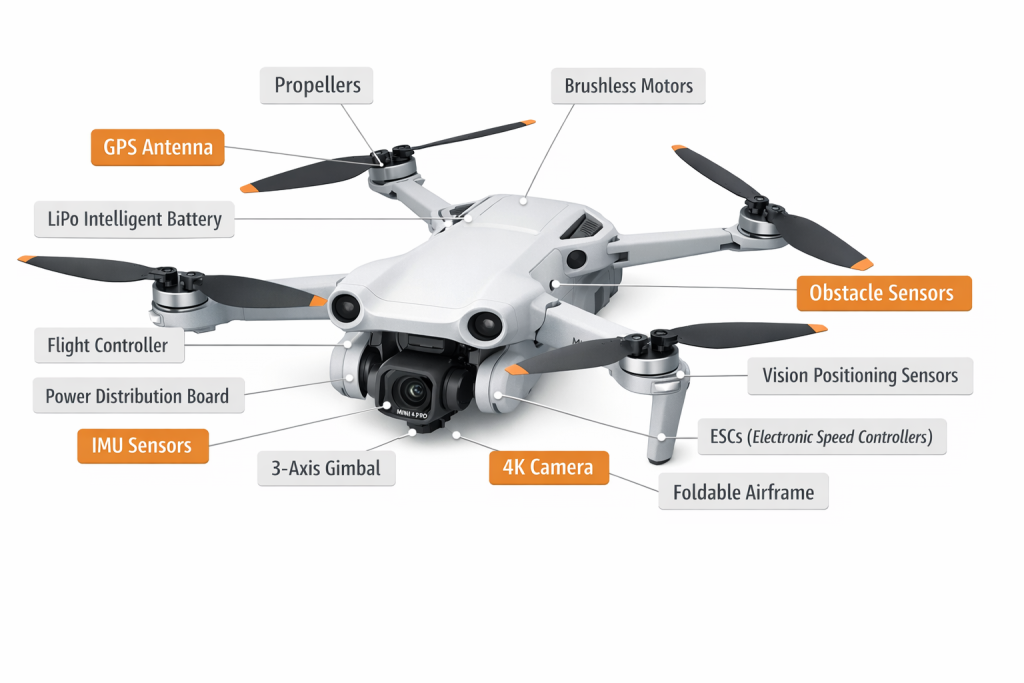
Drones can look simple at a glance — a tidy little aircraft with spinning props and a camera, but underneath that compact shell sits a surprisingly sophisticated system of components working together: the airframe, propulsion, power, sensors, flight controller, gimbal, camera, and communications. Whether you’re a hobbyist learning parts for the first time or a seasoned pro who wants to deepen your systems knowledge, understanding the anatomy of a drone helps you fly safer, maintain your gear better, and make smarter upgrade and troubleshooting decisions.
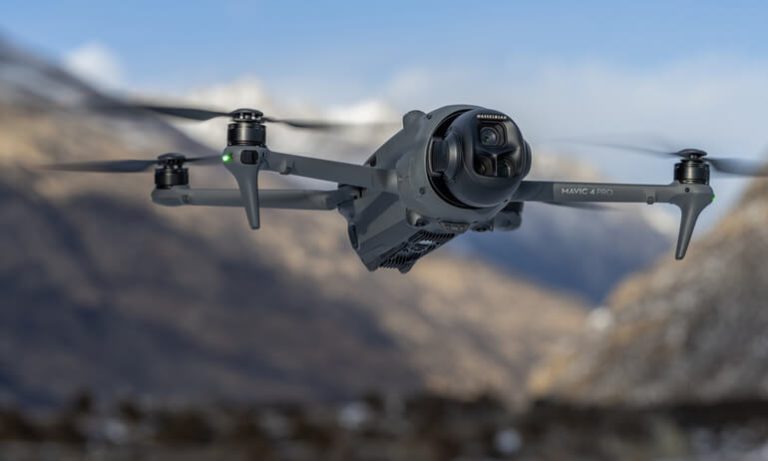
We’ll explain each major subsystem, what it does, how it’s built, and why it matters — using the DJI Mini 4 Pro as a practical reference point throughout. Where helpful, we’ll call out real-world specs (weight, battery, sensors) so you can match theory to an actual, current consumer platform.
The Airframe: the drone’s skeleton and shell
What the airframe does
The airframe is the physical structure that holds everything together. It determines the drone’s size, folding/transport convenience, durability, aerodynamics, and how components are mounted. The airframe protects electronics from vibration and minor impacts and shapes the craft’s flight stability.
Materials and design choices
Common materials: carbon fiber, glass-reinforced nylon (composites), magnesium/aluminum alloy, and engineered plastics. Lightweight materials reduce the power required to hover and help meet regulatory weight classes (e.g., <250 g). A compact, foldable airframe — as used by the Mini 4 Pro — balances portability with structural rigidity. DJI’s mini-series designs aim to keep the package small and under the sub-250 g threshold for fewer regulatory headaches and better travel freedom.
Mounting points and vibration isolation
Critical components (battery, flight controller, motors, gimbal, camera) mount to the airframe. Vibration isolation — rubber dampers, foam, or tuned mounts — prevents high-frequency motor/prop vibrations from reaching the camera sensor. Poor isolation shows up as wobbly video or rolling shutter artifacts. Good airframe engineering reduces these problems at the source.
Propulsion: motors, propellers, ESCs
Electric motors (brushless DC motors)
Most modern camera drones use brushless DC (BLDC) motors. They’re efficient, powerful relative to weight, and durable. Each motor spins a propeller and is controlled by the ESC (electronic speed controller). Motor power and efficiency influence payload capacity, wind resistance, and flight time.
Propellers
Prop shape, pitch, diameter, and material affect thrust and noise. A higher-pitched prop generates more forward thrust at the cost of needing more power; larger props can generate the same thrust at lower RPMs (often more efficient). Foldable props — common on compact drones like the Mini 4 Pro — save space for transport and slightly reduce damage risk in minor tip strikes. Prop balancing is critical: unbalanced props create vibration that degrades video and stresses bearings.
ESCs and motor control
The ESC converts flight-controller motor commands into precise rotor speed. ESCs sample motor RPM and modulate power at high frequency (PWM, DShot, etc.). Modern ESCs include telemetry and current-sensing, letting the flight controller monitor amp draw per motor — useful for detecting binding, a damaged prop, or motor problems.
Want To Learn More About Drones?
Become a Basic Certified RPAS Pilot with the help of our indepth preperation course.
Power system: LiPo / Li-ion batteries, power distribution
Battery chemistry and formats
Most consumer drones use Lithium-Polymer (LiPo) or Lithium-Ion variants optimized for high discharge. The DJI Mini 4 Pro uses an Intelligent Flight Battery (Li-ion variant) with a nominal voltage of 7.32 V and a capacity around 2590 mAh (18.96 Wh); DJI also offers a higher-capacity “Battery Plus” option for extended flight time. These smart batteries contain fuel-gauging electronics and communicate with the aircraft for accurate runtime estimates.
Battery management and safety
Smart batteries monitor cell voltage, temperature, and state of charge. The flight controller receives battery telemetry for low-voltage warnings and automated Return-To-Home (RTH) actions. Proper charging practices, storage voltage (~40–60%), and avoiding extreme temperatures extend battery life and reduce failure risk. DJI documents charging times and recommended chargers; for example, the Mini 4 Pro battery charges in around an hour with appropriate USB-C chargers.
Power distribution
The battery connects to a power distribution board (or integrated power module) that provides regulated voltages to ESCs, flight controller, camera, gimbal, and accessories. This module often includes over-current and short-circuit protections.
Flight controller: the drone’s brain
Functions of the flight controller
The flight controller (FC) integrates sensor data, runs flight-control algorithms, and outputs motor commands. It’s the central processing unit for IMU fusion (gyros + accelerometers), GPS/positioning, barometer altitude hold, and communications with radio telemetry and ground control.
Key responsibilities:
- Stabilization (attitude control — roll, pitch, yaw)
- Position holding (GPS/visual stabilization)
- Obstacle avoidance & flight assistance (receiving data from sensors and path-planning modules)
- Executing autopilot modes (waypoints, RTH, follow me)
- Handling fail-safes (low battery, loss of RC link)
IMU and sensor fusion
The FC depends on a high-quality IMU (inertial measurement unit) — gyroscopes and accelerometers — to sense angular rates and linear accelerations. Sensor fusion algorithms (Kalman filters or complementary filters) combine IMU data with GPS, magnetometer, barometer, and optical flow inputs to produce a stable navigation solution.
Redundancy & flight stacks
Professional systems often use multi-IMU redundancy and dual-flight controllers. Consumer systems, including DJI minis, rely on carefully calibrated single FCs plus robust software stabilization tuned to their platform.
5 — GNSS & positioning: GPS, GLONASS, Galileo, BeiDou
Why GNSS matters
GNSS (Global Navigation Satellite Systems) provides absolute position and velocity data for waypoint navigation, return-to-home, and precise hovering in moderate conditions. The Mini 4 Pro and similar modern drones use multi-constellation receivers to improve lock speed and signal resilience.
Visual Positioning & optical flow
GNSS can fail under dense canopy or in tight urban canyons. Visual positioning — using downward-facing cameras and ultrasonic/ToF sensors — gives short-range stabilization when satellites are weak. The Mini 4 Pro includes optical and infrared sensing suites to allow precise indoor/outdoor hovering and obstacle detection.
Obstacle sensing and scene awareness
Sensor types
Common sensors:
- Stereo/monocular cameras (vision)
- Infrared / ToF (time-of-flight) depth sensors
- Ultrasonic rangefinders
- LiDAR (high-end platforms)
The Mini 4 Pro features an omnidirectional obstacle sensing system (vision + 3D infrared), enabling safer autonomous flight and ActiveTrack behaviours by detecting obstacles in multiple directions. These sensors feed the FC and higher-level autopilot to prevent collisions and plan routes.
Obstacle avoidance vs. obstacle sensing
Sensing = detecting objects and distances. Avoidance = planning and executing maneuvers to bypass them. True avoidance requires both accurate sensing and conservative flight logic. Many compact drones perform admirably in common scenarios but still require pilot supervision in complex environments.
The gimbal: mechanical stabilization for the camera parts
Purpose of a gimbal
A gimbal isolates the camera from frame vibrations and rotational motions, using motors and sensors to keep the camera steady along three axes (yaw, pitch, roll). This mechanical stabilization is what creates cinematic, usable footage even when the aircraft moves.
Types and design
- 2-axis gimbals stabilize pitch and roll (less common for aerial videography now).
- 3-axis gimbals stabilize yaw, pitch, and roll (standard for quality footage).
- Brushless motors on the gimbal react to tiny attitude changes hundreds of times per second.
The Mini 4 Pro uses a 3-axis gimbal to stabilize its camera, enabling smooth 4K footage that would otherwise be unusable from a small platform. Proper gimbal calibration and maintenance (avoid shocks, keep firmware current) preserve performance.
Camera subsystem: sensor, lens, codecs
Sensor size and importance
Sensor size is one of the single biggest factors for image quality. Bigger sensors capture more light, yield better dynamic range, and perform better in low light. The Mini 4 Pro sits in the compact high-performance class with a large-for-its-size sensor and optimized optics that allow strong 4K/60 HDR capture and high-resolution stills. That combination gives hobbyists and pros a lot of creative flexibility.
Lens, aperture, and field of view
A fixed focal length (prime) lens with a reasonably wide field of view gives the cinematic aerial look and minimizes mechanical complexity. Aperture (f-number) controls depth of field and light intake; many mini drones use wide apertures (lower f-numbers) to improve low-light performance.
Image processing and codecs
Onboard image processors handle RAW capture, video encoding (H.264, H.265), HDR processing, and in some models, internal buffering/storage. The Mini 4 Pro supports HDR video and high-resolution RAW photos — features that matter if you plan to colour grade or publish professional work.
Communications: radio links, telemetry, transmission
RC link and video transmission
A drone communicates with the pilot via two primary channels:
- Control uplink: pilot commands (stick inputs, mode switches)
- Telemetry & video downlink: real-time flight data and live camera feed
Modern systems use proprietary digital transmission protocols for low latency and robust links. For example, DJI’s newer O4 transmission standard provides high-quality FHD live video over kilometres in ideal conditions — the Mini 4 Pro advertises long-range FHD feeds up to distances measured in tens of kilometers under test conditions (actual range depends on environment and regulations).
Frequency bands and interference
Transmission uses 2.4 GHz and 5.8 GHz bands (and others in advanced systems). Urban environments have many RF interferers; choosing the appropriate band and maintaining line-of-sight maximizes stability.
Software: flight stack, mobile app, firmware
Flight stack and autopilot
The flight stack is the software running on the FC — stabilization control loops, sensor fusion, mission planning, waypoint execution, RTH logic, and safety checks. Firmware updates tune behavior, improve obstacle sensing, and fix bugs. DJI releases firmware updates for its products (including the Mini 4 Pro) to improve safety and functionality; keeping firmware current is important, but industry best practice is to read change logs and allow early patches to settle before deploying in critical jobs.
Ground control apps
Apps (DJI Fly, etc.) let pilots plan missions, change camera settings, view telemetry, and update firmware. They also surface warnings (airspace restrictions, battery health) and enable features like ActiveTrack, QuickShots, and intelligent flight modes.
Telemetry, logs, and diagnostics
Every modern drone records flight logs, telemetry, and sometimes video metadata and thumbnail images. Logs are invaluable for post-incident analysis, identifying motor issues, or establishing flight parameters for clients and regulators. If you have an incident or a close call, save and export the logs — they form the primary diagnostic dataset for vendor support or official reviews.
Accessories that complete the system
A drone’s core parts are only the start. Useful accessories include:
- Extra batteries and a multi-charger
- ND filters for cinematic shutter control
- Spare propellers and prop-guards
- Hard case or backpack with foam inserts
- GPS tracker or recovery beacon for lost aircraft
- Landing pads (clean, dry takeoffs)
- Telemetry dongles, USB-C cables, and an external monitor for cinematic rigs
For the Mini 4 Pro, DJI offers battery combos and Fly-More packages that extend real shooting time and convenience.
Maintenance, troubleshooting, and practical tips
Preflight checklist (short)
- Inspect props for chips or cracks
- Confirm firmware versions (aircraft + remote + battery)
- Calibrate the compass if moving to a new magnetic zone
- Check the battery State of Charge and health
- Verify GPS lock and home point
- Confirm no local NOTAMs or temporary flight restrictions
Common failure modes & quick fixes
- Excess vibration/jello in footage: balance props, check motor bearings, inspect gimbal dampers.
- Early battery sag: check battery health and temperature; retire cells that have high internal resistance.
- Loss of compass accuracy: recalibrate away from metal and large magnets.
- Signal dropouts: change transmission band or reorient antenna for line-of-sight.
Practical examples: how components work together in a flight
Imagine a Mini 4 Pro launch:
- You unfold the aircraft and press power; the battery reports State of Charge and temp to the FC.
- The FC boots, initializes the IMU, and the GNSS receiver gets a multi-constellation lock.
- The gimbal self-tests and centers; the camera reports sensor settings and storage availability.
- You take off: stick inputs are translated by the FC into motor outputs (via ESCs) while the IMU and GPS maintain position.
- A nearby tree appears: the vision/infrared sensors detect the obstacle and alert the flight stack; if Auto-avoid is enabled, the FC will maneuver the drone to avoid collision while still maintaining the mission or hovering safely.
- The battery drops to a critical threshold: the FC automatically triggers RTH and executes a planned return altitude and safe descent, using sensor data to avoid hazards during return.
This interplay — sensors sensing, FC deciding, motors acting, gimbal stabilizing, and camera capturing — is what produces the reliable, cinematic aerial shots you want.
Upgrades & modular swaps: what you can and cannot change
On many consumer drones, options are limited: you can add ND filters, change propellers, or swap batteries (from approved models). Replacing motors, sensors, or the flight controller is rarely practical without factory parts and recalibration; unauthorized swaps may void warranty and degrade the flight stack’s integrity. For advanced customization, look to hobbyist multicopter builds where frame kits, open flight stacks (e.g., ArduPilot, PX4), and DIY motor choices allow modular upgrades — but they require deep technical skill and regulatory awareness.
Safety, regulations, and operational responsibility
Understanding the anatomy of a drone is only useful when combined with safe operations. Knowledge of where a drone’s sensors have limits, how battery performance degrades in cold, and how the FC behaves near magnetic interference makes you a better pilot. Regulations differ by country; the DJI Mini 4 Pro’s <249 g status reduces regulatory friction in many regions, but pilots must still obey local airspace rules, respect no-fly zones (national parks, emergency scenes), and maintain visual line of sight per national authorities.
Troubleshooting that component-by-component checklist
If your drone behaves poorly, go component by component:
- Airframe: Check for cracks, loose mounts, or deformations.
- Props & motors: Spin motors by hand; check for smoothness and listen for grinding. Replace chipped props.
- Battery: Verify voltage and internal resistance; charge cycles over 200 mean retirement for many cells.
- Gimbal: Run calibration routines; check for mechanical obstructions.
- Camera: Test capture modes, inspect for hot pixels or image sensor issues.
- Sensors: Run vision/IMU calibrations; observe any drift during hover tests.
- Flight controller/firmware: Restore to factory defaults if persistent odd behaviors remain; upload fresh firmware from the manufacturer.
Why component knowledge improves mission planning
If you know the anatomy of a drone, such as motor power, battery runtime, obstacle sensor cone angles, and camera ISO behaviour, you can plan shots that are achievable and safe. For example:
- Don’t plan long-range mapping missions without matching battery count to desired coverage.
- Avoid tight canyon shots if your obstacle sensors have limited downward coverage.
- Prefer early morning or late evening shoots if your sensor’s low-light headroom is limited.
Final words: The Anatomy of a Drone
A drone is the sum of many parts: mechanical structures, electrical power, electromagnetic links, sensors, and advanced software. Each subsystem depends on the others — a great camera is useless without stable power and a steady gimbal; superb obstacle sensing is irrelevant if the pilot ignores alerts.
Learning the anatomy of your aircraft — and using a modern reference like the DJI Mini 4 Pro for concrete specs and behaviours — helps you fly smarter, maintain longer, and create better content. For hobbyists, this knowledge accelerates skill and safety; for professionals, it’s the difference between a successful job and a costly mishap.
Fly safe, maintain your gear, and treat every flight as both a technical and creative challenge.